
A gift may show up as a particular sensitivity, a way of seeing invisible connections, creating clarity, holding complexity, bringing people to life, building systems that work, giving form to the vague, or returning hope where it had almost gone. Professions change; this way of taking part in life keeps looking for new embodiments.
The 11th conference by Anatoly Balyaev
A Gifted Life
On recognising your own gift, creating the conditions in which it can live, and finding the form through which it takes part in the world — through work, creativity, relationships, influence and mutual exchange.
- When
- October 19–22, 2026
- October 19
- Open day, free
- Where
- Online
- Speakers
- 27 people
It happens like this
You can achieve a great dealand one day stop recognising yourself in what you have built
You can build a good, successful, genuinely useful life — and one day notice that the most alive part of you has been given too little room in it, as though joy itself had gone through hyperinflation.
The skills you have in abundance were formed early on: people learn to be reliable, quick, easy to understand, strong, able to meet the expectations of others. These qualities help you become someone, gain a profession and a place in the sun. As you grow older, though, it may turn out that adapting to the world has taken up almost all the space, while what makes you sincere and alive has stayed on the periphery. Your true nature may show up in rare conversations and side projects without ever becoming central. Your particular talents feel too natural to you to be counted as real value.
This discovery does not devalue the life already lived. The earlier form protected you, fed you and, sooner or later, brought you to the place where a next way of being yourself becomes possible.
Sometimes a crisis of meaning means that the fate that shaped you has done its work and can no longer hold the person you have become.
The questions our conference begins with:
- What comes through me so naturally that I barely notice its value?
- What becomes possible for other people when they are around me?
- Where do I feel not only competence, but a particular aliveness, energy and the sense that I am in agreement with myself?
- Which part of my own gift no longer needs the old roles, forms and outside approval?
- Does the life I have arranged support what I would want to keep and develop in myself?
A counter-intuitive world
We hear youand we are responding to what you ask for
- The world has become louder, more anxious and less predictable.
- Events seize attention and demand a constant reaction.
- In that noise a person loses contact with the source of their own aliveness.
- Listening to yourself begins to look like an untimely luxury.
- It is hardest for those who have already come into contact with their essential nature and cannot painlessly give it up.
The conference does not promise to hide anyone from the world. It offers support for staying faithful to yourself inside it.
The genesis of a gifted life
Recognising your own giftis not the same as inventing a purpose for yourself
A gift is not always recognised by inner feeling alone. It takes attention to what repeats across different events, to vivid interest and energy, to the response it evokes in other people. What looks like a gift may well turn out to be a dream of one's own exceptionality. Sometimes a real gift looks ordinary for years precisely because we have lived with it since childhood.
A gift does not place a person above others and does not exempt anyone from work. If anything, it adds responsibility: if something can enter life through us, we have to learn to serve it — to develop mastery, to withstand constraints, to test ourselves against reality, and to create conditions in which the gift is neither squandered nor turned into proof of our own importance.
The path along which a gift becomes a life:
01Recognise
Notice the steady pattern of your own aliveness and influence: what repeats across roles, professions and circumstances.
02Trust it
Take seriously what comes easily, without treating ease as proof of small value or turning your gift into a myth about your own exceptionality.
03Create the conditions
Protect attention, body, time, relationships and environment. A gift lives through a living person and shares the fate of their nervous system, health and capacity to recover.
04Develop mastery
Study, work, meet criticism and limits. Inspiration opens the direction; mastery makes it possible to convey it precisely.
05Find the form
Create a language, a practice, a work, a product, a method, a role or a way of being present through which another person can actually meet your gift.
06Enter the exchange
Let the world answer — with trust, relationships, recognition, opportunities, influence and money — and use that answer to continue living and working.
07Hear yourself again
Even a successful form can grow tight in time. A gifted life keeps returning to its source. It is worth telling apart where the gift is still alive and where we are simply performing a function we have learned to perform well.
Conditions
A gift needs a lifecapable of growing and revealing it
Every person has a gift of their own. The only question is whether they dare to discover it and legitimise it in their own life. Between potential and its embodiment lies a whole life. A gift depends on where attention goes and how, on the way the days are arranged, on whether there is a right to pleasure and rest, on who is nearby, on what visibility costs, and on how much uncertainty one can bear.
Sometimes the talent is there but the soil is thin: everything best goes into surviving, meeting obligations and maintaining the system already built. The gift does not disappear, but it starts living underground — in rare flashes, in unpaid help, in endless preparation, in other people's projects, or in a quiet grievance against a world that seems not to have noticed something important in you.
Preparing that soil means gradually reshaping your relationship with time, the body, work, pleasure and self-regulation. Sometimes it takes the courage to become visible. Sometimes it means giving up a form that looks good and drains you. Sometimes it means admitting that inspiration is not enough and new experience has to be gained and practised. Care for a gift begins where a person stops waiting for ideal conditions and, at the same time, stops sacrificing themselves to the result.
Exchange
Money does not measure a gift,but it takes part in its fate
Price on its own says nothing about quality. A high income does not show whether a person lives from their own gift, and the absence of money does not define the value of what they do. Between a gift and the money paid for it stand clarity, trust, accessibility, agreement, audience, the historical moment and a great many other circumstances.
And still, money cannot be kept outside a conversation about a gifted life. It gives a person time, learning, care for the body. A person receives joy, impressions, knowledge and what other people bring, from the world, works all of it through inside, and returns it through their talent — in work, in creativity, in relationships, in that particular quality of presence they are able to give themselves, the world and other people.
So both sides of the exchange matter. The first is the ability to give a gift a clear and reliable form, to name a price, to accept the world's gratitude without an inner apology, and to enjoy the new possibilities that follow. The second is the ability to handle what has been received so that money supports aliveness, relationships, mastery and further growth, instead of becoming one more form of control and a loss of contact with oneself.
This is how a living circle of exchange appears: the world feeds the person, the person unfolds their gift, and the gift returns more life to the world.

Programme
Four days on how a giftbecomes a life
The conference opens with a free day on October 19: three talks from 11:00 to 13:00. Each of the three main days holds eight talks and ends with an hour-long round table on the theme of the day and on where the conversation has arrived. Twenty-seven speakers take part in all.
- 01October 19, Monday
Open Day
11:00–13:00 Moscow time
Three talks about what all of this is for
The open day is a way in for those still deciding. Three talks in two hours: what we mean by a gifted life, why the conversation starts with recognition rather than technique, and how the three main days are arranged. Taking part costs nothing.
- What a gifted life is, and why the question matters now
- Why the conversation about a gift begins with recognition, not technique
- How the three main days of the conference are arranged
- 02October 20, Tuesday
The Seed
11:00–17:00 Moscow time
How to recognise your own gift and trust it
On the first of the main days we will tell a gift apart from a skill, a mastered function and a social role; look at why what comes naturally seems insignificant to us; explore different lines of ability and that particular pattern of aliveness which runs through different periods of a life. A separate theme will be success inside which a person one day stops hearing themselves.
- How a gift reveals itself in real life
- Why we underrate what comes to us naturally
- Telling a living direction from a fantasy of one's own exceptionality
- What interest, joy, energy and other people's response say about a gift
- Acknowledging your own strength without making it grounds for superiority
In the evening — an hour-long round table on the theme of the day
- 03October 21, Wednesday
Soil and Form
11:00–17:00 Moscow time
What kind of life a gift needs in order to unfold
On the second main day attention moves from the seed to the conditions. We will look at the body and the nervous system, at pleasure and replenishment, at relationships and environment, at discipline and learning. A gift has to exist inside a schedule, a family history, an economic reality and commitments already made. Its growth begins with understanding those conditions, and form emerges when an inner possibility becomes something other people can actually encounter.
- Attention, the body, pleasure and the capacity to recover
- Psychological obstacles, defences and the fear of visibility
- Environment, relationships, learning and how mastery matures
- The language and forms through which a gift becomes recognisable
- Packaging that helps the meeting and does not destroy the living content
In the evening — an hour-long round table on the theme of the day
- 04October 22, Thursday
Price and Harvest
11:00–17:00 Moscow time
How a gift enters exchange with the world, and what that exchange changes
The third main day is about the world's response. Price becomes an agreement between people, money one of the things that make continuing possible, and recognition and influence forms of responsibility. We will also speak about the other side of the harvest: what happens once success has arrived; how pleasure undergoes inflation; why a working form can come apart from its source over time; how to keep hearing yourself when the world asks you to repeat what once worked.
- Price, agreement and the ability to accept payment
- The naturalness of a gift and the right to accept gratitude in material form
- Money as a resource of time, freedom and continued work
- Consumption, pleasure and the inflation of joy
- Success, stability and the need to find a living form anew
In the evening — an hour-long round table on the theme of the day
Speakers
Who will explore this themetogether with us
Twenty-seven speakers will bring different optics into one conversation: psychology and business, creativity and education, bodily experience and relationships, money, professional mastery and personal stories. The difference between these paths makes it possible to see how a person recognises their own gift, creates conditions for it, gets the form wrong, meets the world's answer and returns to themselves again. There can be no ready recipe for a gifted life here.
Names, topics and the exact schedule will appear as participation is confirmed.
01
October 19, Monday
Open DayRound tableAn hour on the theme of the day and on where the conversation has arrived
The theme of the round table will appear later
02
October 20, Tuesday
The SeedRound tableAn hour on the theme of the day and on where the conversation has arrived
The theme of the round table will appear later
03
October 21, Wednesday
Soil and FormRound tableAn hour on the theme of the day and on where the conversation has arrived
The theme of the round table will appear later
04
October 22, Thursday
Price and HarvestRound tableAn hour on the theme of the day and on where the conversation has arrived
The theme of the round table will appear later
Format
How the four dayswill run
- Dates
- October 19–22, 2026
- Where
- Online
- October 19
- Open day, free, 11:00–13:00 Moscow time
- October 20–22
- Main days, 11:00–17:00 Moscow time
- Break
- Lunch from 13:00 to 14:00
- Talks per day
- 3 on the open day, 8 on each main day
- Length
- 30 minutes, including questions and handover
- In the evening
- An hour-long round table on each main day
- Speakers
- 27
- Language
- Russian; talks in English are interpreted into Russian
- Community
- A participants' chat for all four days
Detailed schedule
Speaker names and exact times may shift slightly as the conference runs. The current version of the schedule opens with the button below — save it or pass it on. The file is in Russian.

After the conference
What you will be ableto see more clearly
Three days hand no one a ready-made purpose and promise nothing about a life rearranging itself at once. But a good conversation can give back the distinctions without which we spend years mistaking the habitual for the inevitable.
After the conference a participant will be able to see more closely:
- Which steady pattern their own gift makes across their different roles and occupations.
- Where their life already supports that gift, and where it only uses it as a function.
- Which conditions, which mastery or which form are missing right now.
- What makes visibility, naming a price and accepting the world's answer difficult.
- How aliveness, attention, money, pleasure and stability are connected.
- Which next step is possible without destroying everything already built.
Taking part
Participation for English-speaking guestswas not planned this year
We did not plan to open the conference to English-speaking participants this year, or to interpret it into English. This translation has been made for our English-speaking speakers.
Still, if the theme has caught your interest and you would like to take part after all, write to us. We will try to think of something for you.
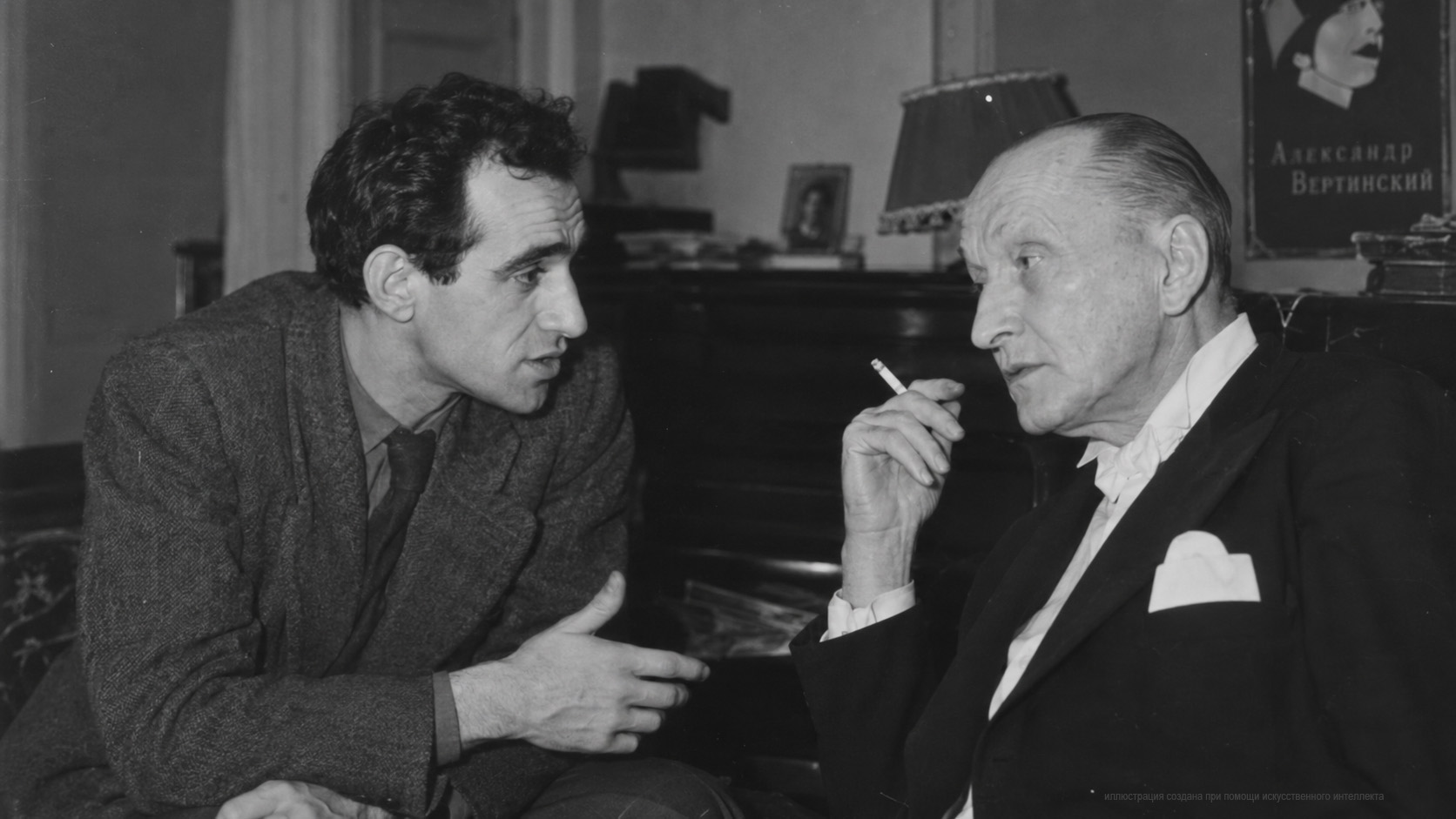
Once at the Central House of Arts Workers in Moscow…
Zinovy Gerdt and Alexander Vertinskyon talent and mastery
The young Zinovy Gerdt stood by the stage of the Central House of Arts Workers — a Moscow club for actors, writers and musicians — watching Alexander Vertinsky perform. In the half-light Vertinsky reigned over the stage, the embodiment of all the grace of the Silver Age. When he finished and came down behind the curtain to applause, Gerdt could not hold back. He walked up to the maestro and, overflowing, began to pour out his delight:
— Alexander Nikolayevich! What happiness, what a great, extraordinary talent you have! It is a miracle, a gift from God, one that opens absolutely every door in art!
Vertinsky listened to this rapturous speech very seriously, without a trace of coquetry. Then he looked at his young colleague and said, in a voice free of any pathos:
“Gerdt, my dear boy… Talent is merely a pass into the room where the Masters sit…”